Read freely
Any text, no account, nothing to install
 Open Source Scripture

A home for human knowledge
Go back in time by reading what people before you wrote and how they saw the world. Some works here were commissioned by Kings, others by divine intervention, but at the end of the day it’s up to all of us to seek the ultimate truths of who we are, where we come from, and what’s happened thus far. There is no greater conveyor of True knowledge than scripture and old buildings—so go travel & read!
Made in the open
Every page comes with the argument that shaped it: who proposed each reading, who backed them, and what the owner decided in the end. Open a text and you can see the whole of it.
Open Source ScriptureSwitch views to see the shelf, the catalogue and a page
The shelf keeps filling, and every text comes with its story: who wrote it, when, and which library still holds the manuscript. No account, no catch — reading is the whole point.
From the page to the text
Nothing here is a summary. Every work is translated page by page from the manuscript it came from, and the original is kept beside the English.
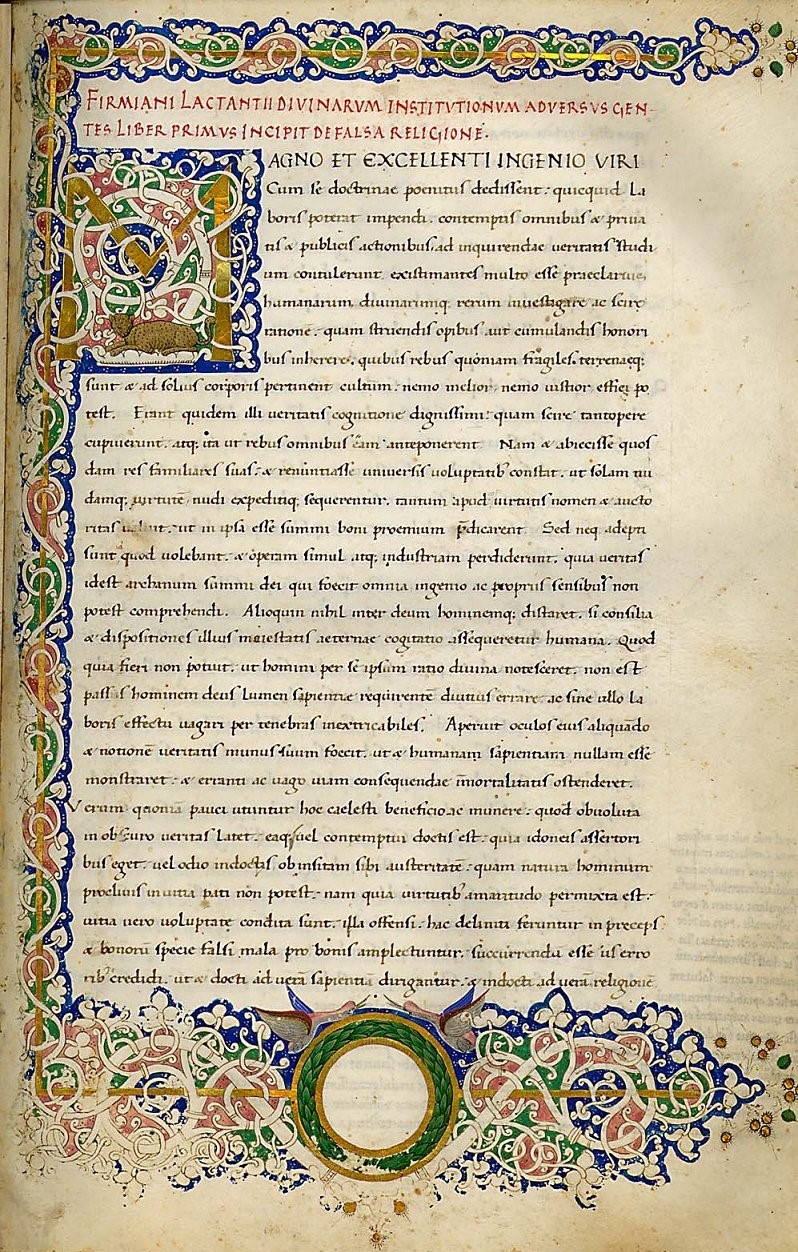
Here begins the book of Lactantius Firmianus, ON THE FALSE RELIGION. How great the truth is, and how useful to know — and that there is no wisdom without religion, and no religion worth approving without wisdom.
Men of great and excellent intellect, when they had devoted themselves completely to learning, applied whatever effort could be expended—setting aside all private and public affairs—to the pursuit of investigating truth.
They considered it far more noble to investigate and understand the nature and ordering of human and divine things than to devote themselves to building up wealth or accumulating honors. For since such things are fragile and earthly, and concern only the care of the body, no one can be made better or more just through them.
Those men were indeed most worthy of attaining knowledge of the truth, which they desired so intensely to know that they placed it above all other things. Indeed, it is known that some of them cast aside their own property and renounced every pleasure, so that, stripped bare and free of hindrance, they might pursue truth alone, naked and unadorned. So great among them was the name and authority of truth that they proclaimed that the reward of the highest good was contained in truth itself.
Yet they did not attain what they desired, and they lost both their labor and their diligence, because truth—that is, the mystery of the Most High God who created all things—cannot be comprehended by human intellect and by our own senses. Otherwise, there would be no distinction between God and man, if human thought were able to attain the plans and arrangements of that eternal majesty.
Since, therefore, it was impossible for man, by his own powers, to know divine reason, God did not allow a human being seeking the light of wisdom to wander forever through inextricable darkness without any reward for his labor. He finally opened his eyes and made the knowledge of truth His gift, so that He might demonstrate that human wisdom is nothing by itself, and so that He might reveal to the wandering and erring man the path for attaining immortality.
But because only a few make use of this heavenly gift and benefit—for truth lies hidden in obscurity—it is either despised by the learned, because it lacks suitable defenders, or hated by the unlearned, because of the severity that naturally accompanies it. For human nature, being inclined toward vice, cannot endure it; because bitterness is mixed with virtue, while pleasure is mixed with vice.
Offended by the one and seduced by the other, men are carried headlong downward; and, deceived by the appearance of good, they embrace evil things as though they were good.
Translated for this library from the Latin on the page beside it. It is on the shelf as Vatican, BAV Pal. lat. 164 — Lactantius, Divinae Institutiones and Three Separate Works (copied at Augsburg, 1468), where this passage is the first leaf. Our other Lactantius manuscript, Pal. lat. 161, has lost its opening quire, so this opening is not in it.
Read this work in the libraryNothing to install
Nothing to install, nothing to sync, no account to make. Open the page and the shelf is already there.
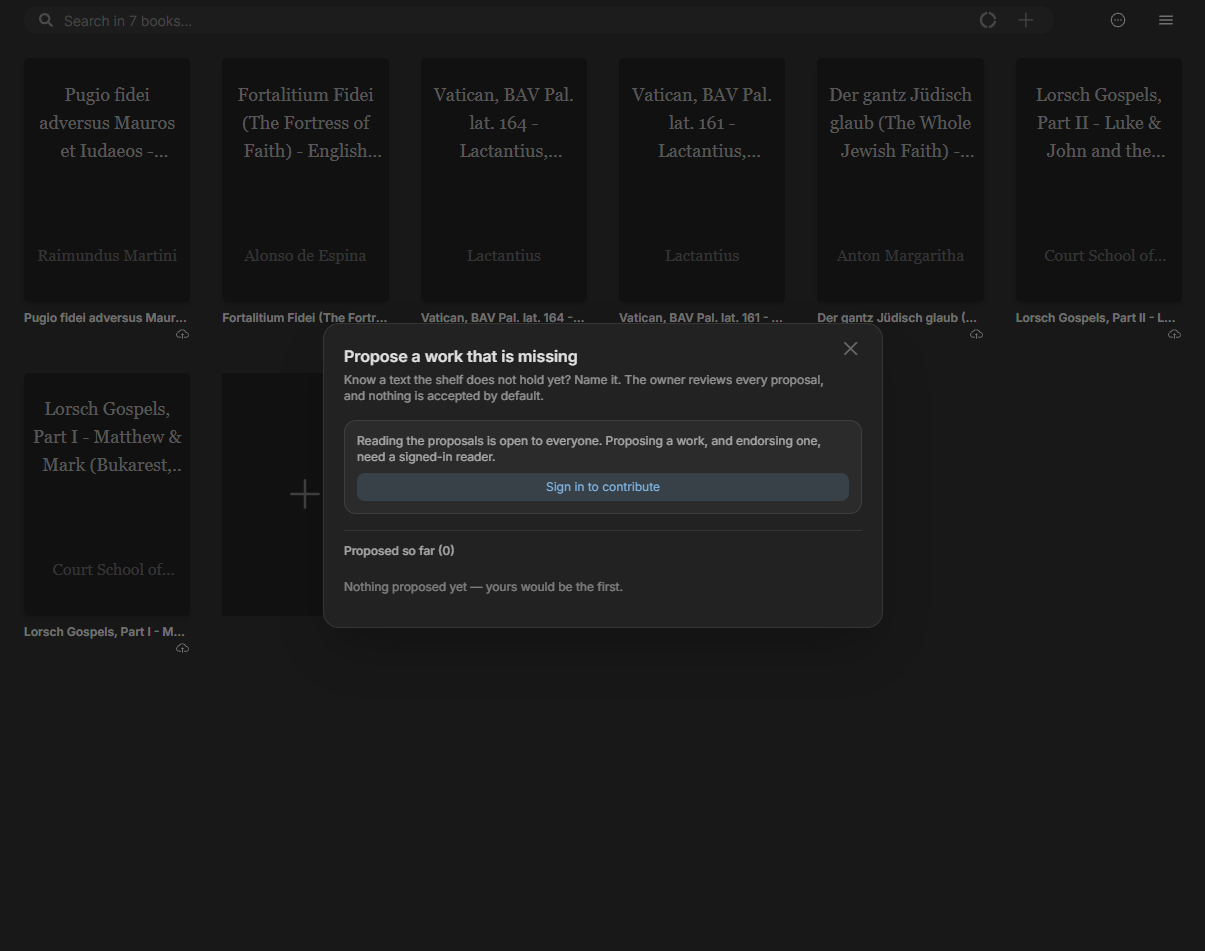
Free to read. Open to improve.
Reading never asks for anything. When you want to change something, sign in with Google and say your piece: your suggestion sits in the open, where anyone can read it, back it or argue with it. The site owner decides what becomes the text.
Any text, no account, nothing to install
Mark a passage and say what it should say
Back the readings you believe are right
Nothing becomes the text by accident
An open canon
The shelf holds scripture and historical texts that had never been put into English — some of them waiting centuries for a reader. Every one is finished before it goes up, so whatever you find here is ready to read, and the shelf keeps growing: far more is waiting than is translated.
The details
The reading comes first, and everything around it is built to stay out of the way — then, when you want it, to show you exactly what has happened to the page you are on.
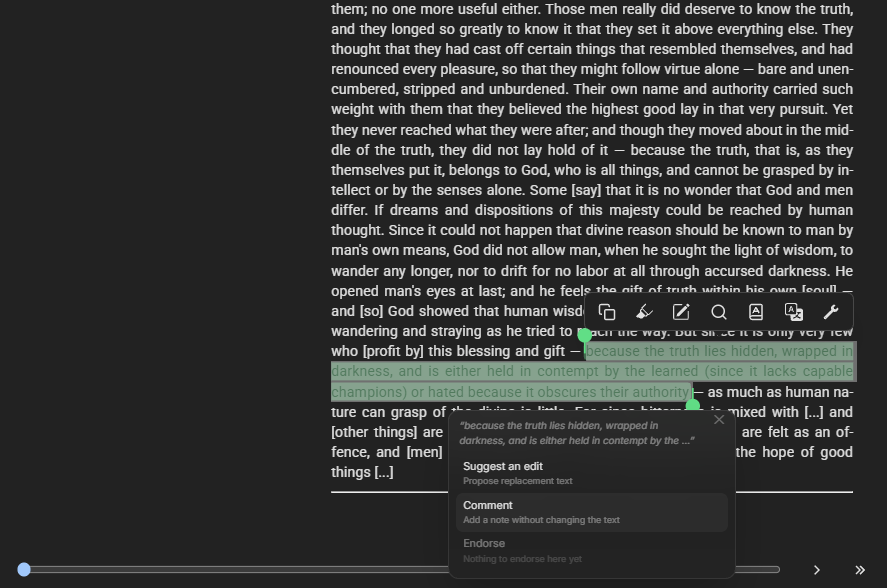
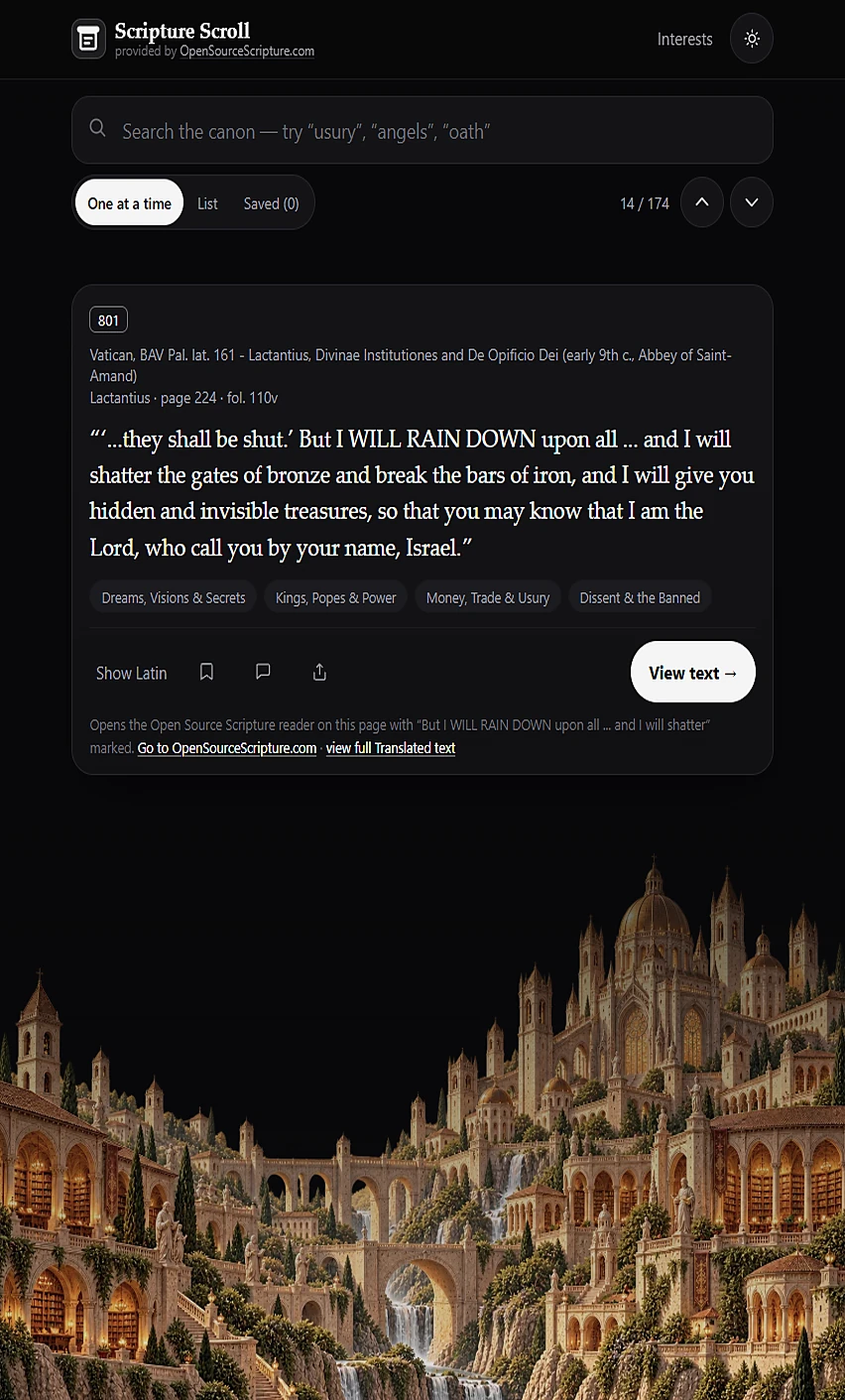
Open a text, keep your place, search everything on the shelf, and mark a passage the moment you have something to add — without leaving the page you are reading.
Parchment by day, candlelight by night — the shelf follows this device.
Made to last
Scripture has been copied, argued over and corrected for centuries by people who cared about getting it right. This is a small part of that, and it is built to keep the record for whoever comes next.
Every text is free to read, with no account and nothing to install.
When a reading is accepted, the change is kept with the name and the date attached. Nothing is quietly rewritten.
What you suggest is a proposal, not an edit. The site owner decides, and the record keeps both the proposal and the answer.
Each text shows where it came from: its author, its year, and the library that holds the manuscript.

The shelf is open
Read anything here for free, with no account. When a passage could read better, say so — anyone may propose a reading, and the record remembers who did.